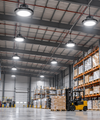

The right LED high bay light for a warehouse depends on ceiling height, floor area, the work taking place and the fixture’s light output. Compare lumens, beam angle and installation requirements alongside wattage to choose a suitable light.
High bay lights are designed for large indoor spaces with high ceilings, such as warehouses, factories, workshops and retail areas. Choosing a fixture based on wattage alone can leave some areas too dim and others over lit.
Here are the main points to check before buying.
1. Check the ceiling height and space layout
Start by measuring the ceiling height and noting the shape of the space. A tall ceiling, shelving rows, machinery and workstations can all affect how light reaches the floor.
Consider where people need clear visibility: aisles, packing stations, loading areas and benches may each have different lighting needs. A lighting professional can help plan fixture quantity and placement for larger or more complex spaces.
2. Compare lumens as well as watts
Watts measure electrical power use. Lumens measure the amount of light a fixture produces. For that reason, wattage by itself does not tell you how bright a high bay light will be.
Check the product specifications for both figures. You can also compare lumens per watt, which shows how much light a fixture produces for the power it uses. The U.S. Department of Energy explains this measure in its commercial and industrial LED lighting guidance.
3. Match the beam angle to the layout
Beam angle affects how light spreads across the floor. A wider beam can cover a broader area, while fixture spacing and mounting height influence whether the light is even or patchy.
The Smart Life Lighting 100W High Bay LED Light lists a 120-degree beam angle, 85–265V input and an IP44 rating. Check the full specifications and consider the conditions in your space before selecting a fixture.
4. Compare high bay options by their listed specifications
Smart Life Lighting lists high bay options including a 100W High Bay LED Light and a 150W UFO High Bay LED Industrial Light.
| Product | Listed wattage | Details to check |
|---|---|---|
| 100W High Bay LED Light | 100W | Listed 85–265V input, 120-degree beam angle and IP44 rating |
| 150W UFO High Bay LED Industrial Light | 150W | Listed 220V, 50/60Hz |
These figures come from the product listings. Confirm current stock and the full product specifications before ordering.
5. Consider the working environment
Dust, moisture, heat and physical impact can affect which fixture is suitable. Check the IP rating and installation instructions against the actual conditions in your warehouse or workshop. If the area is exposed to water, heavy dust or outdoor weather, confirm that the selected fixture is rated for that use.
6. Plan installation and maintenance
High bay lights are installed overhead, so access for fitting and future maintenance matters. Before work begins, check the mounting method, electrical requirements and safe access arrangements. Use a qualified electrician for electrical installation.
For a new installation or a large replacement project, ask for help planning the light positions. A suitable layout can help reduce dark patches and unnecessary over lighting.
Which high bay light should you choose?
For a warehouse or workshop, first identify the ceiling height, floor layout and tasks that need clear visibility. Then compare product lumens, beam angle, input voltage and environmental rating. Smart Life Lighting’s industrial and commercial lights include high bay options to compare.
Quick answer: Choose a high bay light by matching its measured light output and beam spread to your space. Wattage is useful, but it does not show brightness on its own.
Frequently asked questions
What is a high bay LED light used for?
A high bay LED light is used for indoor areas with high ceilings, such as warehouses, factories, workshops and large retail spaces.
Is a higher-wattage high bay always brighter?
Not necessarily. Wattage measures power use. Check the fixture’s lumen output to compare brightness, and review the beam angle and mounting height for coverage.
What should I check before buying a high bay light?
Check lumens, watts, beam angle, input voltage, IP rating, mounting method and the conditions where the light will be installed.
Can I install a high bay light myself?
Because high bay fixtures are mounted overhead and connect to electrical wiring, use a qualified electrician and follow the product’s installation instructions.